 DISTRIBUTED COMPUTE
DISTRIBUTED COMPUTE
DISTRIBUTED COMPUTE
Jobs are assigned directly to idle GPUs that are already pooled — so you start computing without waiting on procurement. JANCTION is the distributed GPU infrastructure (DePIN) behind every JasmyLab service. This page publishes its structure and mechanisms in a verifiable form.
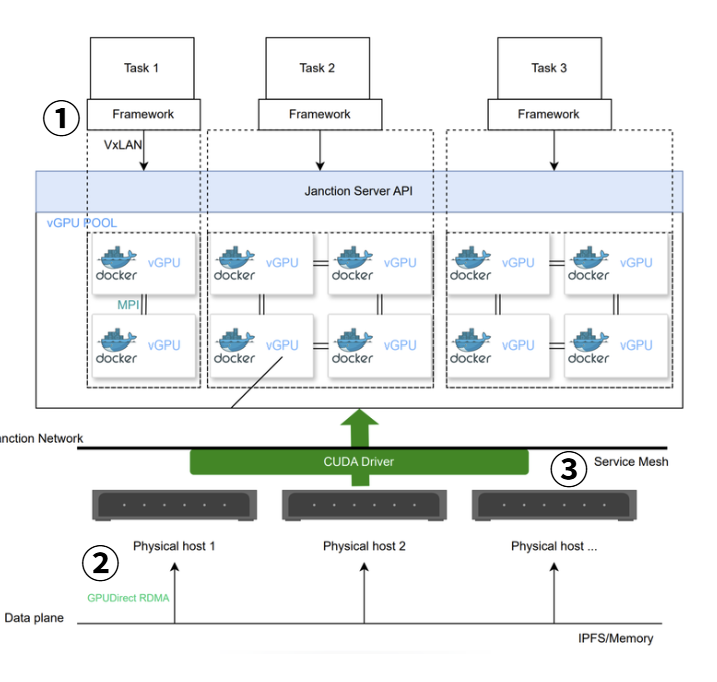
Tasks reach the Janction Server API over VxLAN, framework by framework. They are assigned to isolated Dockerized vGPU containers, and nodes coordinate over MPI for multi-GPU parallel execution.
Physical hosts supply GPUs through CUDA drivers. Hosts transfer data directly via GPUDirect RDMA, and data is shared across IPFS / memory.
Aggregators handle resource discovery and pool formation. They are elected via on-chain staking, so operation does not depend on any single administrator.
We can also walk you through the architecture in our materials.
| GPU virtualization | Physical GPUs split into vGPUs and allocated in isolated Docker containers |
|---|---|
| Network | Pooling via VxLAN overlay; jobs accepted through the Janction Server API |
| Inter-node communication | Inter-vGPU communication via MPI (multi-GPU parallel execution) |
| Host-to-host transfer | Direct data transfer via GPUDirect RDMA |
| Data layer | Distributed data sharing via IPFS / memory (data plane) |
| Execution environment | GPU supply from physical hosts via CUDA drivers |
| Consensus | Two-layer consensus of Proof of Resource + Proof of Task; contribution is evaluated by Proof of Contribution |
| Pricing | Fair pricing and profit allocation via the PVCG (Procurement VCG) mechanism |
| Aggregator election | Elected via on-chain staking (service mesh) |
Source: JANCTION Whitepaper / docs.janction.ai
Miners are rewarded based on performance, while validator cross-verification and reputation scores safeguard quality.
The network verifies that offered GPU resources exist and perform as claimed. Misreported resources cannot join the pool.
Validators cross-verify that tasks completed correctly, and rewards are allocated based on the quality of results.
Node operation history accumulates as a reputation score, deterring fraud and improving allocation quality.
A pricing mechanism designed so that honest reporting is the winning strategy. A provider's true costs and performance, and how much value a user places on the result, are known only to themselves — PVCG takes this information asymmetry as a premise and derives fair prices mathematically.
For the mathematical details, see "PVCG Pricing" in the whitepaper.
Training data is stored on a distributed storage network, with distinct roles maintaining dataset quality.
For due diligence and technical evaluation, please refer to the primary sources in the official documentation.
Our engineering team can walk you through what you need for technical evaluation and due diligence. Material requests are welcome, too.